
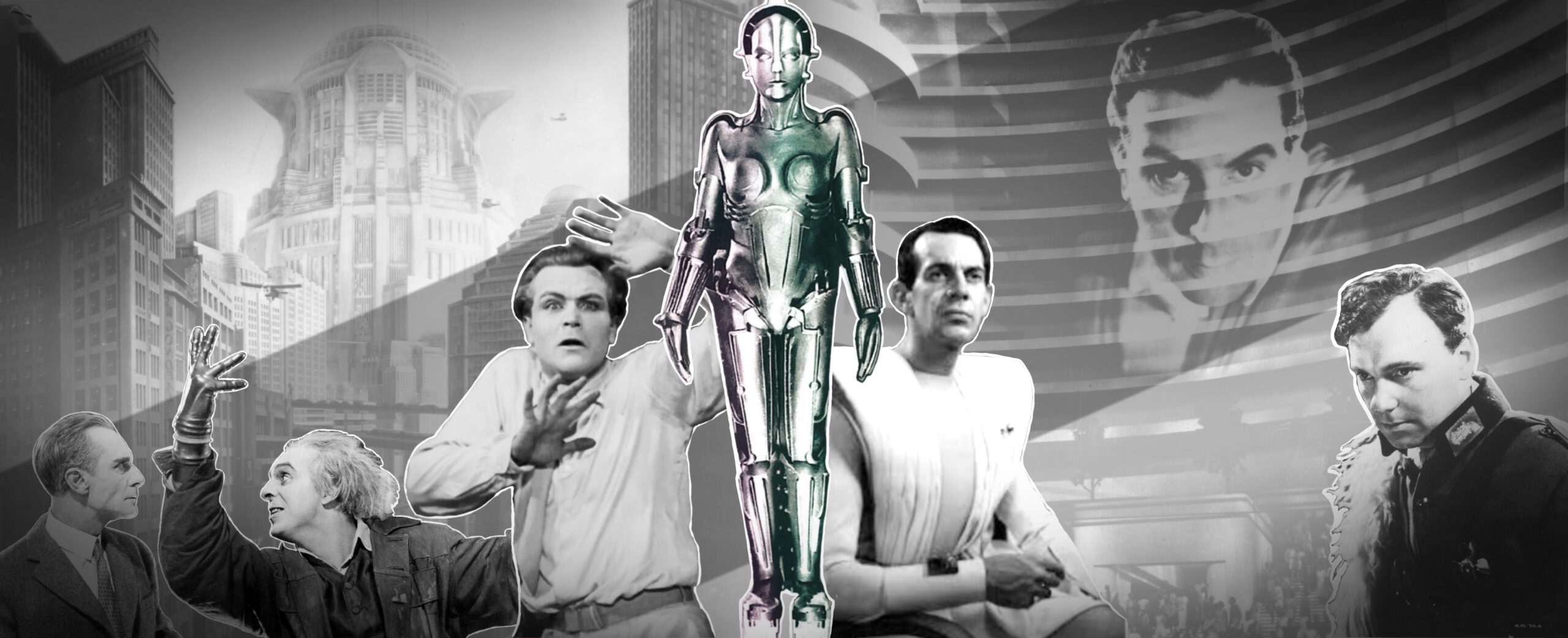
While Science Fiction wasn’t the most popular genre in the early days of cinema (it wasn’t until 70 years later that it overtook the Western), it made occasional appearances on film. The earliest example was Georges Melies’ A Trip to the Moon, a whimsical journey to our nearest heavenly neighbor. But when it came to feature-length movies, the most significant early film is Metropolis, Fritz Lang’s epic tale of a brewing class war set in a giant city.
Metropolis is the forerunner of movies such as Blade Runner and Akira, morality tales set in urban dystopias. The special effects and miniatures in the film created the blueprint for all future genre productions, as well inspiring the poster image on the front page of this website.
At the time, there was a real debate as to whether the United States or Germany would establish itself as what would later become HOLLYWOOD, lit by giant upward-pointing klieg lights. The productions of Germany’s UFA Studios were more artistically ambitious in many ways, with Metropolis being a prime example. The film would be distributed worldwide, garnering the attention of millions. That included the era’s most prominent science fiction author, H.G. Wells, who hated it.
Metropolis
Lang claimed that Metropolis was inspired by his first visit to New York City, though anyone who’s read a biography of the man knows that he never let the truth get in the way of a good story. His then-wife, Thea Von Harbou, had written the screenplay prior to her husband’s visit. Regardless, the story was written and Lang made the movie.
The film is solidly part of a tradition going back to the biblical story of Babylon, which it references. In tales such as this, the city isn’t just a neutral setting, but one in which certain values, be they benevolent or otherwise, are the foundation of the civilizations they portray. Babylon was represented by its eponymous whore, “mother of prostitutes and of earth’s abominations.” (Revelation 17:5), meaning corrupt worldly systems. As in the story of Babylon, the city in the film is biased toward certain ideals. (Incidentally, the film was shot in Neubabelsberg.)
Lang’s Metropolis addresses similar things in part, with the elite and their children living lives of pure hedonism, though it ultimately zooms out to capture a wider view of the city beyond mere carnal sin.
It begins as Freder (called Eric in the original American release), son of the Metropolis’s master Joh Fredersen (nee John Masterman), enjoys the trappings of extreme privilege in one of the pleasure gardens of the wealthy. His escapades are interrupted when Maria, a labor organizer and activist, escorts a group of workers’ children to the nice neighborhood to show them how the other half lives. Struck by her beauty, Freder becomes obsessed. In the process of searching for her, he sees the worker’s city in the depths for the first time, shocked by the conditions in which they live. He sees the workers enslaved to the machines that run the city. He has a hallucination in which the workers are sacrificed to a giant contraption-cum-god that devours them.
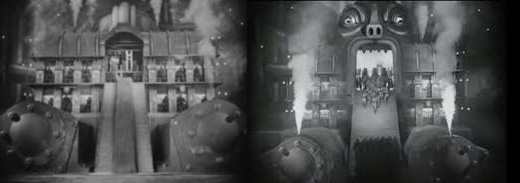
Ultimately he finds Maria and they fall in love, and she becomes convinced that Freder is the prophesized “mediator” that connects the head and the hands of the city. The concept of Babylon isn’t the only thing the film stole from the Bible; here’s also an early cinematic example of the prodigal son.
Joh Fredersen, alarmed by signs of worker discontent, visits an old friend and rival, the inventor Rotwang. Fredersen commissions Rotwang to make a perfect robotic replica of Maria in order to incite a riot, allowing him to utilize force against the workers. However, Rotwang has a different plan. Joh and Rotwang were both in love with the same woman, Freder’s mother, now deceased. Rotwang intends to use the robot to destroy Joh’s beloved Metropolis as an act of vengeance against his romantic rival.

‘Robot Maria’ exhorts the workers to destroy the machines that run the city, ignorant of the fact that in the process they’re also destroying their own homes. Freder and the real Maria rush to rescue the children of the lower city from the flood that engulfs it. Rotwang, driven mad by his failure, kidnaps Maria. After Freder rescues her, he becomes the mediator by joining hands with his father and the workers’ supervisor.
At this time, H.G. Wells was Science Fiction’s most famous author, having built his reputation on books such as War of the Worlds (1898) and The Time Machine (1895). Upon its release, Wells was asked to review Metropolis by the New York Times, and he didn’t hold back. He opens his review by writing “I have recently seen the silliest film. I do not believe it would be possible to make one sillier.”
H.G. Wells on Metropolis
Wells’ review touches on many aspects of the film, from its Catholic philosophy and symbology to his observation that engineering limitations, coupled with the unrelenting advancement of transportation technology, causes cities to grow outward, not upward (which I’ll argue later misses the point).
Still it’s easy to isolate his main objection to the film: he views it as anti-technology. Wells is clearly pro-progress in a technological sense, unsurprising for a Science Fiction author. Some excerpts from his review reveal a belief that technology actually liberates workers from ‘drudge’ work:
“It gives in one eddying concentration almost every possible foolishness, cliché, platitude, and muddlement about mechanical progress and progress in general served up with a sauce of sentimentality that is all its own.”
“You get machine-minders in torment turning levers in response to signals – work that could be done far more effectively by automata. Much stress is laid on the fact that the workers are spiritless, hopeless drudges, working reluctantly and mechanically. But a mechanical civilization has no use for mere drudges; the more efficient its machinery the less need there is for the quasi-mechanical minder. It is the inefficient factory that needs slaves; the ill-organized mine that kills men. The hopeless drudge stage of human labour lies behind us. With a sort of malignant stupidity this film contradicts these facts.”
“The current tendency of economic life is to oust the mere drudge altogether, to replace much highly skilled manual work by exquisite machinery in skilled hands, and to increase the relative proportion of semi-skilled, moderately versatile and fairly comfortable workers . . . what this film anticipates is not unemployment, but drudge employment, which is precisely what is passing away. Its fabricators have not even realized that the machine ousts the drudge.
“’Efficiency’ means large-scale productions, machinery as fully developed as possible, and high wages. The British Government delegation sent to study success in America has reported unanimously to that effect. The increasingly efficient industrialism of America has so little need of drudges that it has set up the severest barriers against the flooding of the United States by drudge immigration. ‘Ufa’ knows nothing of such facts.”
The review makes it clear that Wells believed that technology was key to human PROGRESS – a word he uses in such a way that I’d bet his inner eye had it engraved into stone at the top of a magnificent temple. He thought that machines would eventually eliminate manual labor entirely, and decided to tell everyone what he thought in his very own movie.
Wells’ Real Response: Things to Come
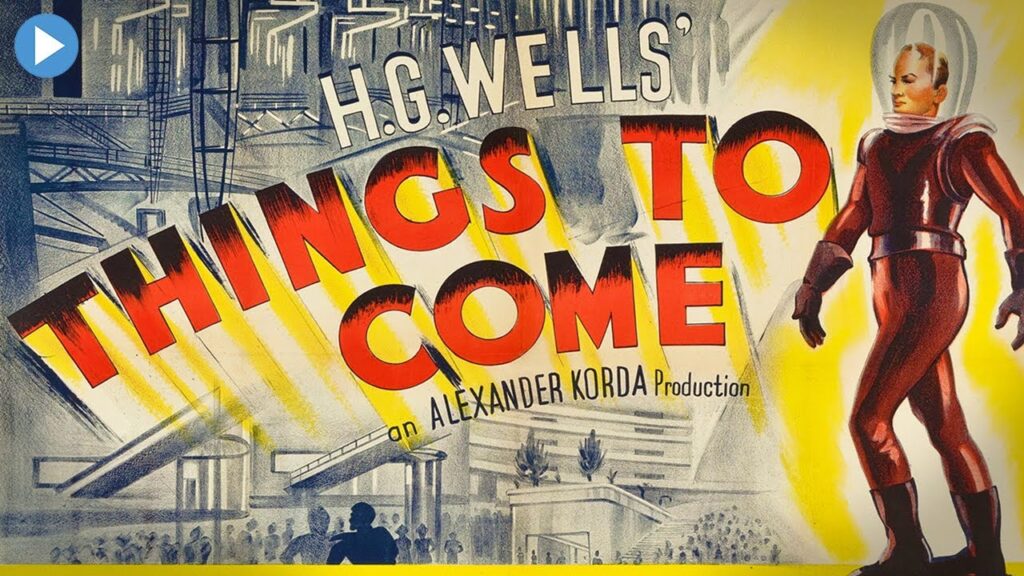
Wells wrote the screenplay for Things to Come from his own novel Shapes of Things to Come, a “future history” detailing the collapse of human civilization in a great war and its recovery into a kind of technologically advanced utopia. Wells instructed the crew to do the opposite of what was done on Metropolis.
It’s a curious film, divided into three sections: there’s a short prologue in an Everytown (literally the name of the town) on Christmas Day. It’s 1940 and Britain is at peace, though everyone is anxious about a war that appears imminent. Not much is made of the cause of the war or who Britain will be fighting, but one character refers to “another speech by him” that antagonizes, a reference to Hitler, certainly.
Here, at his family’s Christmas Party, is where we meet John Cabal, who’s the moral center of the film. All of the overt moralizing is done by him or later, in the third act, by his son Oswald; I guess it runs in the family. He shows a revulsion to war: “If we don’t end war, war will end us.” (An admirable sentiment, but given the threat Europe faced from the Nazis, there’s a solid counter-argument in this case.)
The war they all feared begins at the end of the party with an aerial bombardment. The war continues for thirty years, and decimates Everytown and, by implication, the rest of the world. Disease and war have relegated humanity to barbarism. In 1970 Everytown is ruled by a thug, the “Chief”, in a performance by Ralph Richardson that steals the show. He harangues the mechanics under his command to repair the rotting planes they possess so he can attack neighboring communities. The mechanic despairs that he cannot make a working airplane and thus civilization itself is dead. This mirrors Wells’ belief that civilization is defined firstly by technology and not enlightened values.
Their existence is interrupted by the arrival of advanced aircraft. Piloting it is none other than a much older John Cabal. He is now an emissary from the civilized world, evangelizing about PROGRESS and inviting the barbarians to join their peaceful, technologically advanced community.
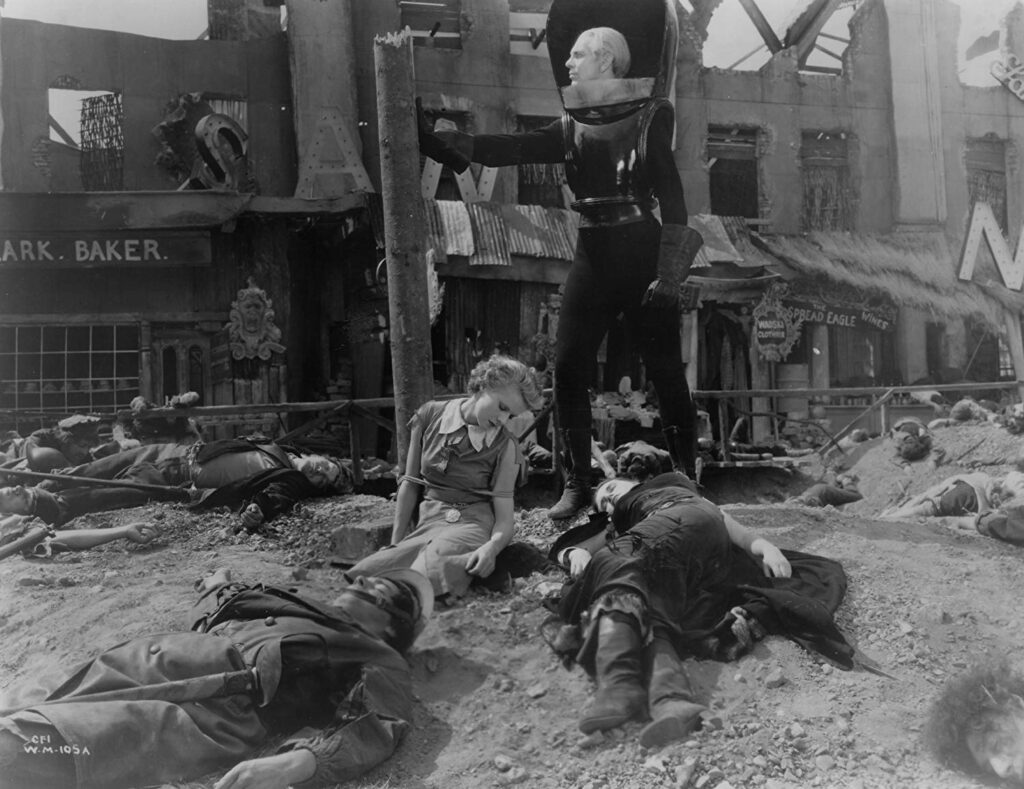
He talks about how their new civilization is a “Brotherhood of Efficiency . . . The Freemasons of Science . . . No bosses, no governing, civilization is to command.” Of course, the Chief takes him prisoner. Ultimately Cabal is rescued by his friends from the so-called Brotherhood and thus the citizens of Everytown are exposed to advancement.
In the third section, the world of the future has been built and Oswald Cabal, John’s son, seems to be in charge. It’s a world of massive structures resembling today’s office buildings and five-star hotels. It’s nice to see that capes come back into fashion someday.
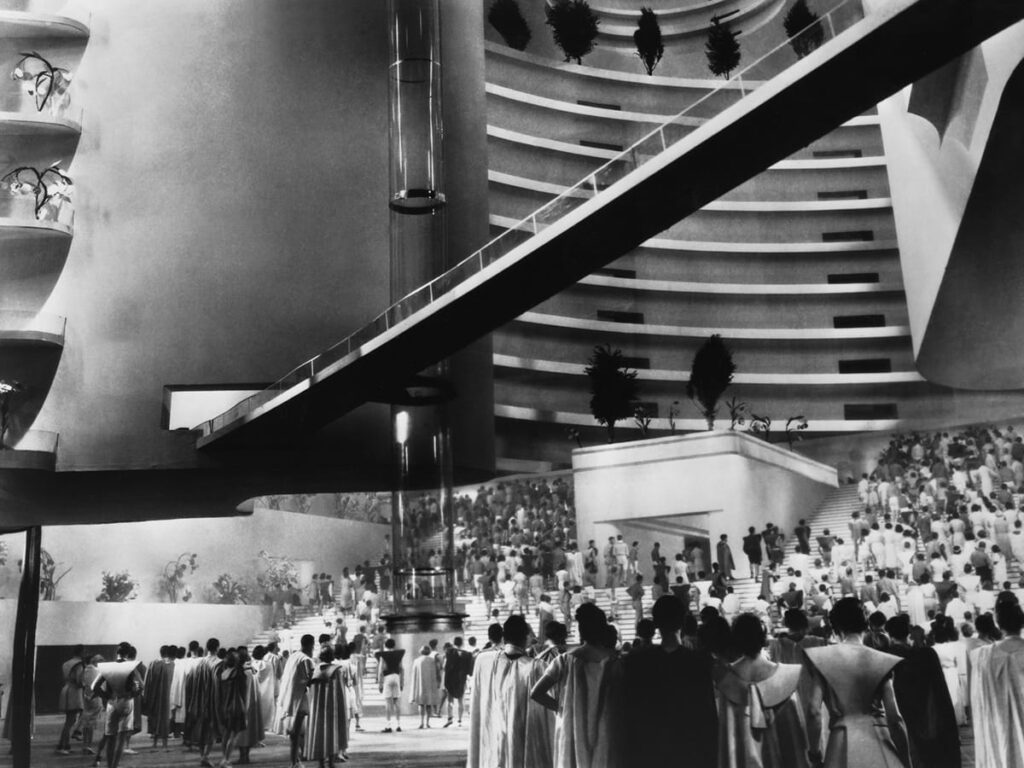
Here we meet another Luddite, Theotocopulos, inveighing against PROGRESS and specifically against the the new Space Gun to launch passengers to the moon. As pointed out in Robert Sacchi’s essay, “[Oswald] muses, ‘I might suppress it but no, they’ll have to hear him and make what they can of it.’ It sounds democratic but when there is a popular uprising against the space gun Oswald proceeds with the moon shot. It’s an example of free speech where the populace can say whatever they want but the powers that be will ignore them. The movie seems to equate intelligence with wisdom and goodness.”
The final word comes as Oswald discusses potential futures with a colleague. A question is posed: “Is there never to be an age of happiness? Is there never to be any rest?” The movie presents these two options as mutually exclusive, happiness or technological progress.
A Contemporary View
When comparing the two, it has to be said: regardless of what your beliefs are, Metropolis is the better movie. While neither movie is particularly subtle, Metropolis uses more artistry to convey its message, while Things to Come has endless speechifying to tell you exactly what to think. Movies as a medium were still young, but artists such as Chaplin had started to develop a visual language that eventually created the art of film, leading to the pithy phrase “show, don’t tell.” Judging by the movie, Wells didn’t know how to do this.
Wells mocked Metropolis in his review for the vertical form of the city and the way its machines enslave the workers. I think that he mistook the portrayal of an actual city with a metaphorical one. Lang came from German Expressionism, an artistic movement that portrayed not the physical reality of the world, but the underlying forces that powered it. The vertical form of the city is meant to represent classism as a force, the upper class literally on top and the working class in the depths.
And while machines might ease the efforts of workers (a laudable goal), they haven’t eliminated classism as a whole. The weight of a free market society still falls on the workers. Their enslavement to machines isn’t literal, but a representation of the dynamics they’re subject to.
This segues into the main philosophical clash about technological progress. Lang and Von Harbou view technology as a potentially negative and corrupt force, personified by Rotwang and the robot, while Wells believes it to be the ideal of human civilization. Given the new era of technological change we live in, I think most of us would be ambivalent about some of the changes we’ve seen and experienced.
In his review, Wells wrote about how machinery eliminates only drudge work, freeing workers to engage in activities that require human initiative and creativity. One wonders how he would view the age of A.I., which could cause massive unemployment as software replicates the actions of more skilled workers, not just manual laborers.
Many of Wells’ conclusions are embarrassing in hindsight. Again, he imagines a future with “no bosses, no governing, civilization is to command.” That sounds a lot like anarchism, but rather than the agrarian societies that would likely emerge in an anarchistic society, the future world of Things to Come has giant buildings resembling today’s skyscrapers, hotels, and shopping malls. Those are things that come to exist in a society with a strict hierarchy, not one with “no bosses”. In a voiceover at the end of the movie, Oswald talks about “tearing out the wealth of the planet” as a positive thing while a montage shows giant excavators destroying the natural landscape. Now that we know of the environmental impact of activities such as mining, I doubt the modern viewer will look at it entirely the way Wells did.
Still, the film stands as an interesting, though not convincing, counterpoint to Metropolis. And it’s not as if Metropolis is perfect either. As I wrote, it contains no subtlety in its message and it’s still unclear how capital is amassed in their city. It also has Lang’s recurring portrayal of women as either a virgin or a whore (which he brought with him to America after leaving Germany).
Speaking of Lang’s departure, Germany’s bid to become the home of popular cinema died when the Nazis took power and their best filmmakers, many of them Jewish, made the wise decision to leave, like Lang.
Both films are remarkable in their own way, but I think in both artistry and philosophy, history has concluded that Metropolis is the superior film.
Recent Comments